NBA Live Betting Strategy: In-Play Tactics for Real-Time Wagering
 Available in US
The Celtics trailed by 14 points at halftime. I watched the live spread tick from Boston -1.5 to Boston +8.5 as the third quarter began, and something felt wrong about that adjustment. The Celtics had shot 31% from three in the first half – a number that screamed regression rather than continuation. I bet Boston +8.5 live. They won by 6. That sequence captures everything compelling and dangerous about NBA live betting: the market moves fast, opportunities appear and vanish within minutes, and your ability to process information in real-time determines whether you capture value or chase losses.
Live betting now commands 62.35% of the US online sports wagering market, with projections suggesting continued growth through 2031. The NBA’s structure makes it particularly suited for in-play wagering – high-scoring, momentum-driven games where leads evaporate and resurge constantly. A 15-point deficit with six minutes remaining is not safe. A 10-point lead entering the fourth quarter is not secure. This volatility creates continuous betting opportunities that pre-game markets cannot offer.
For UK bettors, NBA live betting presents unique challenges alongside its opportunities. Games tip off late evening at the earliest, with many running past midnight and into early morning hours. Betting sharp at 2am requires different discipline than betting at 2pm. The comprehensive NBA betting guide covers all market types; this piece focuses specifically on the real-time tactics that separate profitable live bettors from those who simply add action to games they are watching.
How NBA Live Odds Move During Games
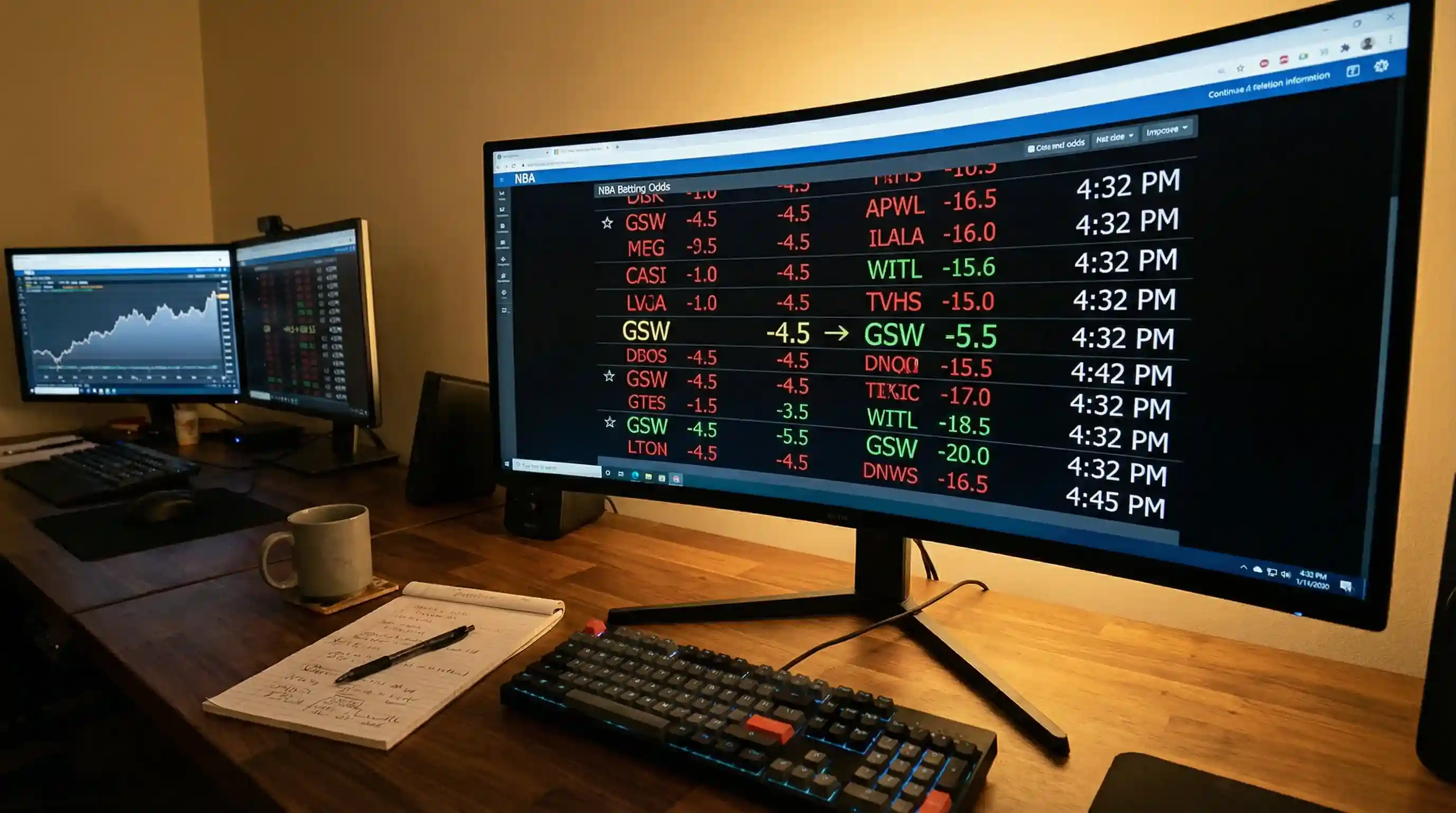
Live NBA odds operate on algorithms, not humans. The moment a basket drops, the software recalculates probabilities and adjusts lines accordingly. Understanding this mechanical reality is essential because it explains both the opportunities and limitations of live betting. The algorithm responds to what has happened; it does not anticipate what will happen next.
Scoring runs trigger the most dramatic movements. An 8-0 run over two minutes might shift the spread by 4 points – more than the actual scoring margin suggests. Algorithms weight recent events heavily because recency often predicts near-term continuation. This creates opportunities when you believe the run will stop or reverse. The team that just surrendered 8 straight points calls a timeout, makes a substitution, adjusts their defence. The algorithm sees 8-0; you see a correction coming.
Foul trouble creates market inefficiencies that live bettors can exploit. When a star player picks up his third foul early in the second quarter, the algorithm adjusts for his reduced expected minutes. But the adjustment is generic – it does not fully account for whether that specific team has a capable replacement or whether the situation will force the coach to play the star despite foul risk. These contextual factors take time to price correctly, creating windows for informed bettors.
Research shows that 19% of NBA games are decided in the fourth quarter alone. This figure tells you something important about live betting: early leads often do not hold. A team up 12 after three quarters might feel dominant, but nearly one in five games will flip in the final period. Live odds at the end of the third quarter still carry meaningful uncertainty, even when the scoreboard suggests otherwise.
Quarter breaks and timeouts pause the live market briefly while bookmakers reset their models. These pauses often result in adjusted lines that differ from what you could have bet moments earlier. Sharp live bettors learn to anticipate these adjustment windows and position themselves before the pause when they have conviction about the post-pause direction.
Injury and substitution information reaches different bettors at different speeds. If you are watching the game, you see a player limp off before the bookmaker processes the injury report. This information asymmetry creates edges for attentive live bettors – but only for seconds or minutes before the market adjusts. Speed matters in live betting more than any other market.
Quarter-by-Quarter Betting Approaches
Each quarter of an NBA game presents distinct betting characteristics. Treating all 48 minutes the same ignores the structural differences in how teams approach different periods. Some bettors specialise in specific quarters because patterns emerge that generalised live betting misses.
First quarters offer the purest matchup information uncontaminated by score effects. Neither team is chasing; neither is protecting a lead. Starters play their normal minutes against opposing starters. The betting here depends almost entirely on your pre-game analysis of how the teams match up. If you believe the pre-game spread is wrong, the first quarter often provides a concentrated test of that belief before game flow introduces noise.
Second quarters introduce rotation patterns that create volatility. Starters rest; bench units face each other. Teams with deep benches gain advantages during these stretches. A team might lead by 4 after the first quarter and then surrender the lead when their weak bench faces the opponent’s strong second unit. Knowing which teams have bench advantages – and which opposing coaches will exploit them – creates second quarter edges the market may not fully price.
Halftime represents a natural reset point. Coaches make adjustments. Players get extended rest. Whatever happened in the first half gets partially discounted as the game effectively restarts. I find halftime live spreads particularly interesting because they incorporate first-half results but reset the contest to 24 minutes. If you believe a team made poor shooting luck in the first half, halftime offers a chance to bet on reversion without carrying the baggage of the pre-game line.
Third quarters historically favour certain teams and coaches. Some coaches are known for excellent halftime adjustments; their teams consistently outperform third quarter spreads. Other teams fade after halftime. These patterns are quantifiable – you can find third quarter point differentials for every team – and they persist with enough consistency to create betting edges.
Fourth quarters bring starters back but also introduce game state effects. Teams protecting leads play differently than teams chasing. Fouling strategies accelerate scoring in the final minutes. Garbage time emerges in blowouts, making totals unpredictable. The fourth quarter is the hardest to bet because so many non-basketball factors influence outcomes – clock management, intentional fouls, and teams coasting to finish.
Late fourth quarter live betting requires understanding whether the game is actually competitive. A 12-point lead with four minutes left is different from a 12-point lead with ninety seconds left. The trailing team’s approach – whether they are fouling to extend possessions or conceding – determines whether the spread has meaning. Watching the body language tells you more than the algorithm knows.
Reading NBA Momentum Patterns
Basketball momentum is both real and overstated. I have watched teams ride 15-0 runs to commanding leads, only to surrender 18-0 runs moments later. The sport’s structure – frequent scoring, quick possessions, constant substitutions – makes momentum transient. This transience creates live betting value because markets often overreact to runs that will not sustain.
Runs typically trigger counter-runs. A team down 10 calls timeout, tightens their defence, and answers with their own scoring burst. This pattern repeats throughout games with enough regularity that assuming run continuation is often wrong. When you see a 12-2 run shift the live spread dramatically, ask yourself: is this team actually playing differently now, or did they simply make shots they were missing earlier?
Timeout impact depends heavily on coaching quality and context. Some coaches use timeouts to stop runs; others seem to wait too long. The coach calling the timeout also matters – a timeout by the team on the run often has different effects than one by the team suffering. Learning which coaches effectively use timeouts and which struggle with in-game adjustments creates edges that pure algorithm pricing misses.
Star player rest patterns create predictable momentum windows. When a team’s primary scorer sits, their offence typically regresses toward their bench production level. The opposing team often makes runs during these stretches. Knowing rotation patterns – when stars typically rest, how long they sit, whether coaches adjust rest in competitive games – helps anticipate momentum shifts before they appear on the scoreboard.
Defensive intensity fluctuates more than offensive capability during games. A team might play elite defence for six minutes, then relax and surrender easy baskets for the next four. These intensity fluctuations create scoring runs that reflect effort more than talent. Live betting edges exist when you can identify which runs stem from effort changes (likely to revert) versus scheme success (potentially sustainable).
Late-game momentum carries different significance. A team down 8 with three minutes left must play desperately – fouling, pressing, taking quick shots. This desperation can create runs in either direction. Sometimes the trailing team catches fire and closes the gap; other times their desperation leads to turnovers and transition baskets for the leading team. Reading which scenario is unfolding requires watching the game, not just the scoreboard.
Live Spread Betting Tactics
Live spread betting rewards patience and contrarianism. The best opportunities typically come when the market has overreacted to early results – when a slight favourite falls behind and their live spread extends far beyond what the underlying matchup justifies. Buying low on quality teams after slow starts has been my most consistent live betting edge.
Home court advantage persists through live adjustments, but markets sometimes forget this. Average NBA home court advantage sits around 3 points, and this edge does not disappear because the home team trails early. A home favourite that opened -4 and trails by 6 after the first quarter might have a live spread of +5. But that same home court factor still applies – the market has potentially overcorrected based on twelve minutes of play.
Regression to the mean applies to live spreads more than casual bettors expect. A team shooting 60% from three in the first half will almost certainly shoot worse in the second half – league average is around 36%. A team allowing opponents to make 70% of their shots near the rim is suffering bad luck that should improve. Live spreads based on unsustainable first-half shooting create value on the correction.
Blowout situations present unique spread dynamics. When a game becomes non-competitive, starters sit and the spread becomes about bench-versus-bench matchups that neither team cares much about. Garbage time scoring is unpredictable in both directions. I generally avoid live spread bets in blowouts unless I have specific bench-depth information that suggests value. The variance increases while the edge decreases.
Specific spread numbers matter less in live betting than pre-game because you are choosing from whatever the market offers at that moment. You cannot shop for the best number when lines move every possession. This means accepting slightly worse numbers than you would pre-game – but compensating by only betting when the mispricing is large enough to overcome that disadvantage.
The closing minutes require different spread thinking. With two minutes left and a team up 6, the live spread might be -5.5. But the actual margin depends on whether the trailing team fouls and whether the leading team makes free throws. These end-game mechanics make late spreads feel almost random. I rarely bet live spreads in the final three minutes unless the margin is large enough to absorb late fouling variance.
Live Totals Betting Strategy
Pace reveals itself within the first quarter. If your pre-game research suggested a slow, grinding game but both teams are running and scoring freely, the live total probably has not adjusted enough. Conversely, a game projected as high-scoring that settles into half-court defence in the first quarter might offer live under value. Pace establishes early and tends to persist.
Defensive adjustments happen at halftime more than at any other point. A team that surrendered 65 first-half points typically tightens defensively in the second half – coaches make that adjustment, and pride kicks in. Live totals at halftime sometimes fail to account for this defensive intensity increase. Second halves tend to score lower than first halves, a pattern the live market may not fully capture.
Blowouts affect totals in counterintuitive ways. You might expect blowouts to produce high scores as the winning team piles on, but garbage time often features reduced effort from both sides. Starters sit; bench players take inefficient shots. A game on pace for 235 points through three quarters might finish at 218 because the fourth quarter features two bench units going through the motions. This garbage-time scoring depression creates under value in some blowout situations.
Tracking live possessions gives you information the algorithm lacks. If both teams are playing slowly, using the shot clock, and focusing on half-court sets, total possessions for the game will fall below projections. Fewer possessions means fewer scoring opportunities regardless of efficiency. Watching game tempo – not just current score – reveals whether the live total is mispriced.
Foul trouble affects totals through pace disruption. Free throws stop the clock, slow the game, and reduce the total number of possessions. A game with many fouls will feature more dead ball time and fewer overall scoring opportunities than a clean game. When you see foul rates rising early, the under becomes more attractive as total possessions decline.
Late-game totals become highly situational. A close game with both teams trying to win features normal basketball. A blowout features garbage time scoring. A game where the trailing team must foul features rapid free throw attempts that inflate totals. Reading which scenario is unfolding determines whether the live total offers value or is priced correctly for the specific end-game situation.
Live Betting NBA from the UK: Time Zone Challenges
Most NBA games tip off between midnight and 3am UK time. This schedule creates a fundamental challenge: are you sharp enough at 2am to make good live betting decisions? I have learned, expensively, that my late-night betting quality degrades significantly. The discipline I maintain at reasonable hours evaporates when fatigue combines with the desire to make a losing night profitable.
Weekend afternoon games offer the best UK live betting windows. Games starting at 5pm or 6pm Eastern translate to 10pm or 11pm in the UK – late, but manageable for bettors who want to watch and bet simultaneously. These weekend matinee slots often feature nationally televised games with significant betting interest, creating reasonable liquidity and competitive lines.
UK gambling statistics reveal that 95% of online betting happens from home. For NBA live betting, this means you are probably on your sofa at 1am, laptop open, game streaming on television or a second screen. This environment invites casual, poorly-considered bets. The friction of betting – which helps restrain poor decisions – disappears when you can bet with a few clicks from the comfort of your home.
Pre-selecting games prevents late-night wandering. Before any NBA evening begins, I decide which games deserve live betting attention and which I will ignore entirely. This pre-commitment reduces the temptation to bet random third-quarter spreads on games I barely researched simply because they are the only action available at 3am. Fewer, better bets beats more, worse bets.
Recording games for morning viewing sacrifices live betting opportunities but preserves sleep and decision quality. If you know you cannot bet sharp at 2am, watching games the next morning while avoiding scores lets you still enjoy the basketball without risking tired, impulsive wagers. This approach acknowledges that not every opportunity needs to be exploited – sometimes the best bet is the one you do not make.
Session time limits protect both bankroll and health. Staying up until 4am watching West Coast games might seem worth it in the moment, but the accumulated sleep debt affects the rest of your week. I set firm ending times – typically 2am on weeknights – regardless of what betting opportunities might emerge in later games. This boundary preserves sustainable engagement with NBA betting over a full season.
Risk Management for Live NBA Betting
Live betting creates impulsive betting opportunities that pre-game markets lack. The game is happening now; the line is moving now; the window is closing now. This urgency can override analytical thinking and trigger emotion-driven decisions. Managing this impulsivity separates sustainable live bettors from those who blow through their bankrolls chasing in-game swings.
Pre-set limits on live betting exposure provide crucial structure. I allocate a specific portion of my nightly NBA budget to live betting and stop when that allocation is exhausted – regardless of how many “obvious” opportunities remain. This hard cap prevents the chase mentality that destroys bankrolls. Missing a good late-game opportunity because you hit your limit is disappointing; blowing your entire bankroll because you had no limits is devastating.
NBA Commissioner Adam Silver has advocated for more regulation of sports betting, noting the need to monitor promotion levels and advertising around gambling. His perspective matters because it acknowledges that the betting industry has created products specifically designed to encourage action. Live betting is one such product – its real-time nature generates excitement that benefits bookmakers more than bettors in aggregate.
Taking breaks during games prevents compounding losses. If your first quarter bet loses and you immediately bet the second quarter to recover, you are chasing. Stepping away – getting a drink, checking your phone, doing anything other than staring at betting markets – creates space for rational assessment. The next opportunity will come; there is no urgency that justifies betting angry or desperate.
Loss limits specific to individual games prevent catastrophic single-game exposure. I will not lose more than a set amount on any one game through live betting. Once I hit that threshold, that game is closed for live action regardless of what happens next. This rule prevents the scenario where you keep betting on the same game, convinced it will turn, until you have far more exposure than the situation justifies.
Recognising emotional betting states requires honest self-assessment. Are you betting this live spread because your analysis supports it, or because you want the team to cover for entertainment reasons? Are you chasing a loss from earlier? Are you tired, frustrated, or bored? These emotional states produce bad bets. Developing the self-awareness to identify them – and the discipline to stop betting when they arise – is more valuable than any tactical edge.
What is the best quarter to bet on NBA games live?
No single quarter is universally best – each offers different opportunities. First quarters test pre-game analysis without score effects. Third quarters often feature coaching adjustments and can reveal halftime changes. The best quarter depends on your specific edge: if you analyse bench depth well, second quarters might suit you; if you read momentum shifts, third quarters offer more variance to exploit.
How quickly do NBA live odds change?
NBA live odds adjust almost instantly after scoring plays, with algorithms recalculating probabilities in real-time. During fast breaks or scoring runs, lines can move multiple points within minutes. Timeouts and quarter breaks pause live markets briefly for manual review. Sharp live bettors must act quickly – opportunities that exist for thirty seconds may not exist a minute later.
Can I watch NBA games while live betting from the UK?
Yes, most UK streaming services and bookmaker apps offer NBA game streaming alongside live betting markets. The NBA League Pass provides comprehensive coverage, and many UK bookmakers include streaming for customers with active accounts. The time zone challenge is more significant than access – games typically run midnight to 4am UK time.
Is live NBA betting riskier than pre-game betting?
Live betting carries higher variance due to faster decision-making, emotional pressure from watching games in real-time, and less time for analysis. The rapid pace can lead to impulsive bets that pre-game consideration would prevent. However, live betting also offers unique edges from watching game flow that pre-game analysis cannot capture. Risk depends heavily on individual discipline and approach.
Published by the nba Betting Chart team.